
Mariona ESPINET
Lleida, 1987
The way a person organizes their surroundings says a lot about how they inhabit the world.
In the work of Mariona Espinet, an artist based in Barcelona, each painting becomes an invitation to reflect on what it means to build a home. Her perspective stems from a solid background in interior design, complemented by studies in architecture, yet it finds freedom through the language of painting, allowing her to explore more sensitive and abstract dimensions of space.
From the beginning of her professional career, Espinet has been linked to the field of architectural design, with a particular interest in how spaces are transformed into habitable places, ready to be filled with experiences.
Over time, painting became for her an ideal medium to investigate the more subtle aspects of interior design: those related to perception, emotion, and the energy that emanates from forms and colors.
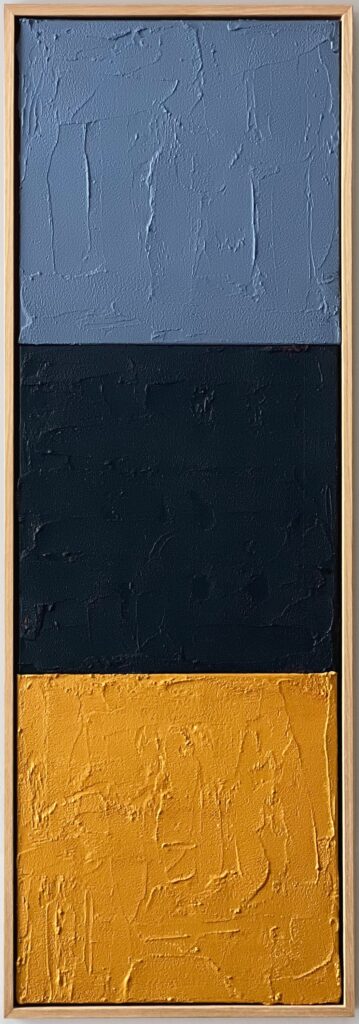
The study of color occupies a central place in her work. Beyond a purely aesthetic exploration, Espinet, drawing on her knowledge of color psychology, investigates how it can become a channel for emotions.
Through compositions that incorporate organic geometries, irregular patterns, and deliberately imperfect shapes, the artist explores the tensions between emptiness and fullness, stillness and movement. In her work, abstraction becomes a vehicle for representing not only visible space but also the space that is felt or intuited.
Espinet suggests that both painting and architecture construct spaces through the relationship between surfaces. However, while architecture operates within physical boundaries, painting allows her to escape those restrictions and open up a field of more symbolic possibilities. In this intersection between the concrete and the ethereal, the artist gives shape to what she conceives as a “visual home”: an inner space where introspection and spiritual connection converge.
Her chromatic choices are not arbitrary: Espinet masters tonal transitions with precision, modulating each color with subtle touches of white and black to generate light, shadow, and depth. This way of working enables her to build dense visual planes, charged with emotional resonance.
Her palette does not seek the impact of monochrome, but instead unfolds a harmony capable of sustaining the identity of each piece and activating in the viewer an almost meditative experience.